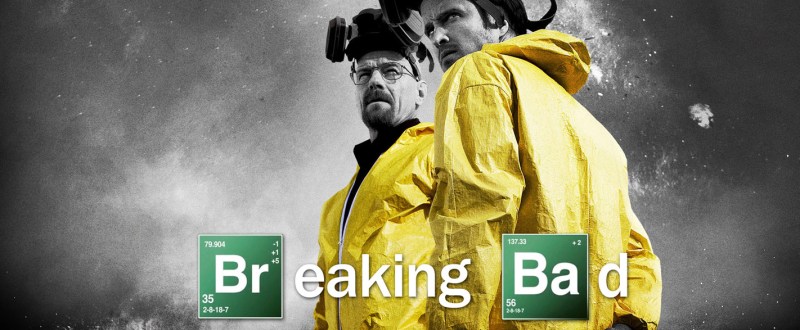
All ‘Breaking Bad’ Things Must Come to a (Hopefully Good) End

I love Breaking Bad. When I started watching it on Netflix I blew through all of the episodes in probably a week or two. Its intense and compelling story of meth cooking and drug dealing is itself a drug, and I’m an addict.

This is why I was so bummed when it didn’t win any Golden Globes this past weekend. Bryan Cranston, especially, I thought deserved to win best actor in a television drama series. Granted, I haven’t really watched Homeland (don’t kill me) or any of the other shows with actors up in this category except for Mad Men (and mm, Jon Hamm – I would have been okay with his beautiful mug winning too), but I still find it hard to imagine that anyone could have done anything better than Cranston’s gritty, complex, and oddly endearing performance.

With only half a season left, Breaking Bad is soon sadly coming to an end, but I think it is a testament to Vince Gilligan’s expertise at what he does that this series does have an end in mind. Rather than just trying to take the show as long as he possibly can, stringing us all along, it’s actually going somewhere. This is an important thing to keep in mind for anyone who is devising, writing, running, directing, or producing a television series. In the end, you don’t want to leave things hanging or bore your viewers with an aimless overarching narrative. Despite the serial nature of the medium, you still have to have a complete story and a conclusion in mind.

In this article Vince Gilligan discusses the difficulties of concluding the series. It’s definitely an interesting read. Let me know what you think of his comments and his process. How do you think it should end?

Ten Things on Vince Gilligan’s Mind As He Writes the Final Episodes of Breaking Bad
Denise Martin @ Vulture

130115-breakingbadarticle

We’re not gonna please everyone, we’re not gonna please everyone … This is what I keep telling myself so I can sleep at night,” Vince Gilligan laughed last month, even though he wasn’t exactly joking. When he spoke to Vulture, he was putting the finishing touches on the story for the third to last episode, getting very close to tackling the series finale (the show’s last stretch of eight episodes airs on AMC later this year).
Read More >

The Stupidity of the Winter Hiatus

I don’t know about you, but with the Golden Globes last night (although I didn’t get a chance to watch them live and have yet to sit down and watch a recording), pretty much marking the official return of good TV to TV after the winter hiatus, I am pumped.

I always thought it was incredibly stupid that during breaks from school and work there was nothing new on TV. This article explains how the holidays, traditionally seen as a low-viewership period of time, may actually offer a lot of potential to television networks, and they should take note.

How do you feel about the winter hiatus? Do you use it as a break to catch up on shows, or do you too, feel like you’re wasting away with nothing to watch?

Wasting Away in the Winter Hiatus
Liz Medendorp @ PopMatters

130114-winterhiatusarticle

Recently we were back in that time of year when TV hits a dry spell: the infamous Winter Hiatus, when no new episodes are aired from about mid-December to mid-January. If you’re anything like me, you’re anxious for things to start up again, growing bored out of your mind watching the only things available to you: reruns, holiday specials you’ve seen dozens of times, and drawn-out New Year’s Eve shows. Why must we endure this dearth of good television precisely during that time of year when pretty much everyone has time off?”

Read More >

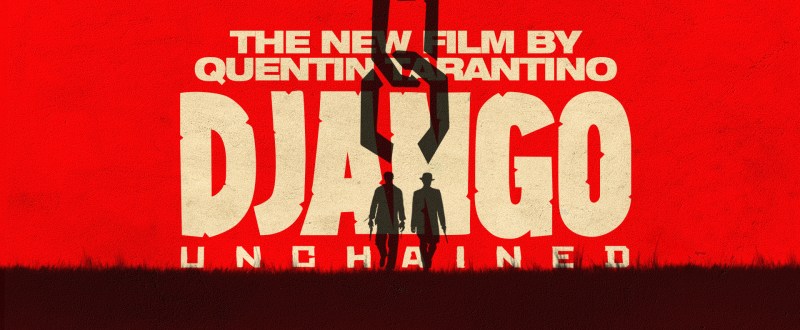
Tarantino on the Censorship Controversy of ‘Django Unchained’

Even though it’s been out for over two weeks now, I can’t resist at least a brief discussion of the controversy surrounding Django Unchained, especially because of how closely related it is to my own adoption of the moniker “mewling quim”.

Django Unchained uses the n-word approximately 110 times in its 166 minutes, a level of vulgarity that has caused some uproar. My first reaction to the arguments against it was simply that, coming from Quentin Tarantino, what do you really expect? He is known for excessive violence and language in his films, almost to the point of satire, and that is honestly what is so great about them.

The whole issue reminds me a lot of the episode of South Park, “It Hits the Fan” (S05:E01) that took a stance on censorship through the excessive use of the word “shit”–they even kept a counter at the bottom of the screen of how many times it was uttered in the episode, reaching 162 by the end of the half-hour show. This episode emphasizes the fact that the more a word is used, the less impact it starts to have. It seems to me that this is exactly the point of Django Unchained, as it is meant to realistically reflect its setting at a time and place when the n-word was not offensive. Words change their meaning and their import over time, so why are we so concerned that Django Unchained uses the n-word 110 times instead of 10? Would it be less offensive if there were fewer instances of the word?

But even more importantly, as the interview with Tarantino below reflects, the “excessive” use of the n-word in Django Unchained is not actually excessive, because “no one can actually say with a straight face that we use the word more than it was used in 1858 Mississippi.” And to me, this is the overriding principle in terms of censoring film and television–and creative productions in general: if it’s something that the character would say, then they should say it. You have to be truthful to the characters you write.

One of the most interesting aspects of this interview is that, in response to the Drudge Report posting a splash page of Tarantino across the top of its front pages with the n-word written below it seven times, Tarantino indicates that they were trying to offend him. An ironic state of affairs when you consider the fact that many see Tarantino himself as the one who is being offensive. His reaction to this intended slight is incredibly admirable–he doesn’t let it offend him. He simply says that what they did was ridiculous, and he can’t take it seriously.

What do you think of the controversy surrounding Django Unchained? Check out the interview with Tarantino here.

Quentin Tarantino Isn’t Fazed By ‘Django Unchained’ N-Word Controversy
Kevin P. Sullivan @ MTV

130113-tarantinoarticle

It should come as no surprise that Quentin Tarantino‘s latest film — which we’ll remind you is a slavery-era tale told in Spaghetti Western style — has stirred up some controversy. What is slightly shocking, however, is that much of the controversy is coming from media coverage of “Django Unchained” as opposed to the movie itself.

Read More >