Tarantino on the Censorship Controversy of ‘Django Unchained’

Even though it’s been out for over two weeks now, I can’t resist at least a brief discussion of the controversy surrounding Django Unchained, especially because of how closely related it is to my own adoption of the moniker “mewling quim”.

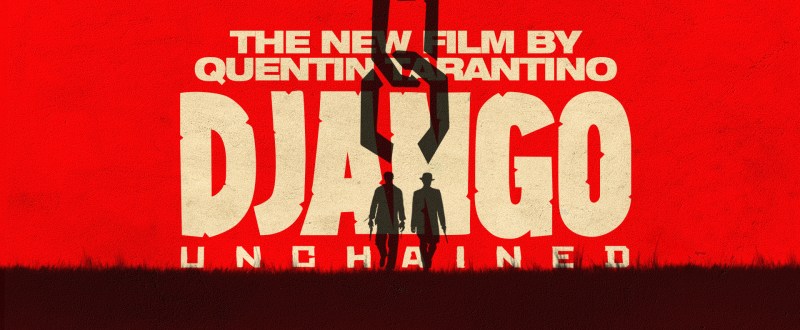
Django Unchained uses the n-word approximately 110 times in its 166 minutes, a level of vulgarity that has caused some uproar. My first reaction to the arguments against it was simply that, coming from Quentin Tarantino, what do you really expect? He is known for excessive violence and language in his films, almost to the point of satire, and that is honestly what is so great about them.

The whole issue reminds me a lot of the episode of South Park, “It Hits the Fan” (S05:E01) that took a stance on censorship through the excessive use of the word “shit”–they even kept a counter at the bottom of the screen of how many times it was uttered in the episode, reaching 162 by the end of the half-hour show. This episode emphasizes the fact that the more a word is used, the less impact it starts to have. It seems to me that this is exactly the point of Django Unchained, as it is meant to realistically reflect its setting at a time and place when the n-word was not offensive. Words change their meaning and their import over time, so why are we so concerned that Django Unchained uses the n-word 110 times instead of 10? Would it be less offensive if there were fewer instances of the word?

But even more importantly, as the interview with Tarantino below reflects, the “excessive” use of the n-word in Django Unchained is not actually excessive, because “no one can actually say with a straight face that we use the word more than it was used in 1858 Mississippi.” And to me, this is the overriding principle in terms of censoring film and television–and creative productions in general: if it’s something that the character would say, then they should say it. You have to be truthful to the characters you write.

One of the most interesting aspects of this interview is that, in response to the Drudge Report posting a splash page of Tarantino across the top of its front pages with the n-word written below it seven times, Tarantino indicates that they were trying to offend him. An ironic state of affairs when you consider the fact that many see Tarantino himself as the one who is being offensive. His reaction to this intended slight is incredibly admirable–he doesn’t let it offend him. He simply says that what they did was ridiculous, and he can’t take it seriously.

What do you think of the controversy surrounding Django Unchained? Check out the interview with Tarantino here.

Quentin Tarantino Isn’t Fazed By ‘Django Unchained’ N-Word Controversy
Kevin P. Sullivan @ MTV

130113-tarantinoarticle

It should come as no surprise that Quentin Tarantino‘s latest film — which we’ll remind you is a slavery-era tale told in Spaghetti Western style — has stirred up some controversy. What is slightly shocking, however, is that much of the controversy is coming from media coverage of “Django Unchained” as opposed to the movie itself.

Read More >

Anticipating Sci-fi in 2013: ‘Star Trek Into Darkness’

I was raised on the bread and butter of Star Trek. My parents have always been huge fans of the original series, and I, myself, was a mite addicted to The Next Generation for a good portion of my middle school years. That being said, I never really got into any of the Trek movies–something about that universe just seems to be better suited to the long-format, serial narrative of television.

However, when the rebooted Star Trek film came out in 2009, I absolutely loved it. Apparently some have criticized it for being a dumbed-down version of the greatness that it came from, but I, personally, loved the shit out of it. It had all of the action and suspense you would expect of a sci-fi film, but it also was extremely clever in how it dealt with the inevitable fan criticism if it contradicted the Trek canon in any way. How did they manage to avoid the ire of the passionate and snarky Trekkie (or apparently some prefer “Trekker”) community? Take the reboot outside of the canon. It’s literally a different timeline, which, in the first place, totally works for sci-fi, and second, opens up limitless possibilities for where they can go with these beloved characters. In a sense, it seems like it could be the beginning of another series, as it could be particularly well-suited to long-format narrative.

Also, Zachary Quinto.

This article reviews some of the most anticipated sci-fi films of 2013, but personally, Star Trek Into Darkness is definitely at the top of my list. Now that J.J. Abrams has the entire Star Trek universe to play with, I can’t wait to see where he takes us. One point of contention, however: with so much at his fingertips, why is he bringing us back to Khan? Don’t get me wrong, I love Wrath of Khan (1982) and it’s probably my favorite of the Trek films before the reboot, but really, Abrams? Really? You could have done practically anything, and instead you decide to go back to a staple of the Star Trek film franchise and do what, remake it too?

So despite all the hope I have that it will be a great film, I am just really really hoping that Into Darkness isn’t a let down.

What films are you most looking forward to this year?

The Seven Most Anticipated Sci-fi Films of 2013
Jacob S. Hall @ movies.com

130112-scififilmsarticle

A few weeks ago, I wrote a column dissecting a random grab bag of upcoming science fiction films, with a few of the titles mentioned not set to open until 2014. But now that we’re at the start of a brand new year, it’s time to narrow this column’s focus to the next 365 (well, 361 days). It’s time to start getting excited about movies that actually have solid “we can’t go back now” release dates.

In other words: here are the most intriguing, exciting and potentially great science fiction films opening within the next 12 months. Spoiler alert: Oblivion and After Earth aren’t included.”

Read More >

‘Dredd’: An Under-Appreciated Adaptation

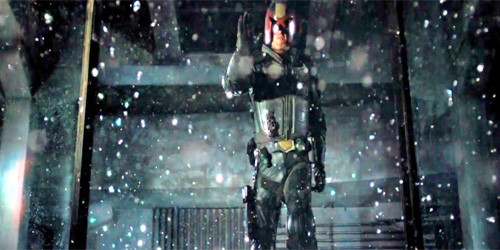
The British science fiction film Dredd, an adaptation of the comic book series Judge Dredd, with no relationship to the awful 1995 Sylvester Stallone film version, has unfortunately flown under the radar. With its DVD and Blu-ray release just two days ago, I hope that it may garner some more attention.

The setting of the film alone is incredibly intriguing–a dystopian future where most of Earth is too dangerous to inhabit because of high levels of radiation, so most of the world’s population is crammed into massive conglomerates of cities, rife with crime and violence. But beyond that, this film has some incredible action sequences, stunning and innovative visuals, and impeccable acting on the part of Karl Urban (Judge Dredd) and Lena Heady (Ma-Ma, a ruthless drug lord and gang leader).

So why is it that almost no one went to see this film? I, myself, didn’t even hear about it until I saw it on the local theater’s movie showtimes. I think this is a testament to the fact that promotion was far too limited here in the States for this great British film, but the article below discusses some of the added reasons why this under-appreciated film may simply not have what it takes to appeal to mainstream audiences.

Have you seen Dredd? Tell me what you thought of it!

Slow It Down and Violence Is Made Beautiful in ‘Dredd’
Liz Medendorp @ PopMatters

130110-dreddarticle

Dredd is a visually stunning, action-packed, and subtly funny British science fiction comic adaptation, yet it flew under the radar—only partly due to minimal promotion in the States. Beyond that, although Dredd admirably stays faithful to the spirit of the original comics, this approach in some ways limits the film’s appeal. With no epic narrative, no major growth in the protagonist, and a focus on the entrancing visuals rather than on plot or character development, Dredd is a great film that simply doesn’t fit the mainstream formula.”

Read More >